Greens That Won't Forgive You
Cape Arundel plays under 5,900 yards. On paper, that's a short course. On the ground, it's a different game entirely — because Walter Travis made the greens the main event, and he didn't build them to be fair. He built them to make you think.
Who Was Walter Travis?
Before he was an architect, Travis was a golfer — and an unusual one. He didn't pick up a club until age 35, then became the first American-born player to win the British Amateur in 1904. His calling cards were precision and course management, and when he turned to design, those values shaped everything he built.
Travis was a transitional figure. He came after the raw Scottish links-builders but before the Golden Age titans like Ross, Macdonald, and Tillinghast. His style bridges worlds: strategic enough for a thinking player, bold enough to hold up against modern equipment — particularly around the greens.
At his best courses — Cape Arundel, Garden City, Ekwanok, Westchester — Travis created something distinct: short, clever, heavily contoured designs where the putter matters as much as the driver.
The Travis Green
You can spot a Walter Travis green from the fairway. It's the one that doesn't look flat anywhere.
His greens share a DNA:
- False fronts. A ball landing short doesn't trickle on — it rolls back to your feet. Travis believed the approach shot was a game of precision, not hope.
- Internal spines and shelves. The green is rarely one surface. It's two, or three, separated by ridges that turn a 20-foot putt into a negotiation.
- Small targets. Many Travis greens at Cape Arundel are postage stamps compared to modern expectations. You're not aiming at the green. You're aiming at the correct third of the green.
- Chocolate-drop mounds. His signature — rounded, sculpted bumps around the edges of greens and fairways. They look decorative. They aren't. A ball that catches one deflects in unpredictable directions.
The effect is cumulative. No single green at Cape Arundel is unfair. But over 18 holes, the precision required wears you down. Miss in the wrong spot and you're not two-putting. You're grinding for bogey.
The Course
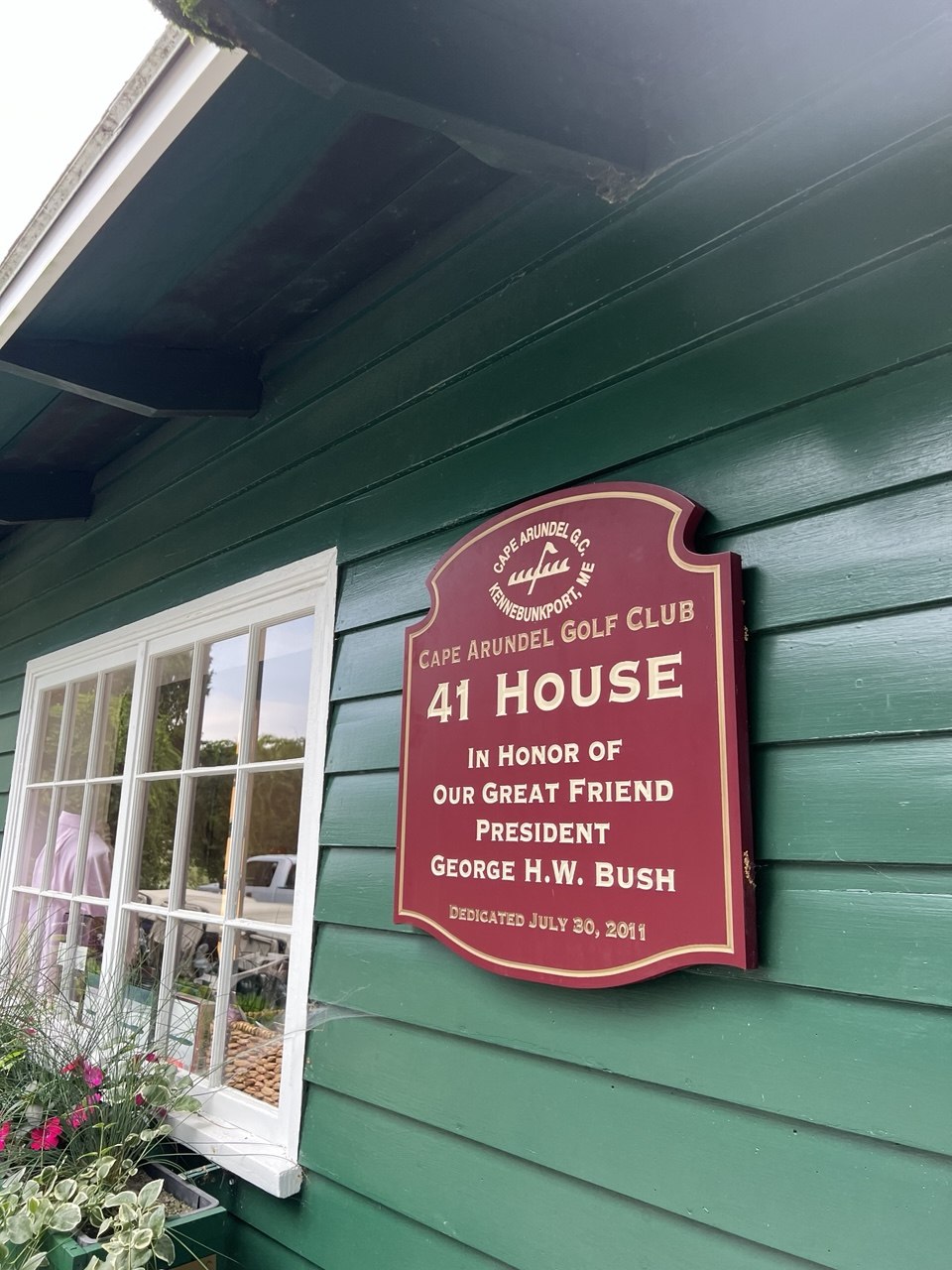
Cape Arundel sits along the Kennebunk River in southern Maine, a few miles from Walker's Point — the Bush family compound. George H.W. Bush played here constantly, enough that the club named a building behind the tee boxes the "41 House" in his honor. His father, Prescott Bush, was club president in the 1920s.
The routing uses the river as a quiet presence, especially on the back nine. The front nine plays inland through stands of pine and oak. The back opens up, with water views and the kind of seaside light that makes late-afternoon golf in Maine feel like a different sport.
Holes That Matter
10th — The Signature Par-4. Downhill, bending right, with Travis's chocolate-drop mounds guarding the inside corner. Cutting the corner requires carrying the mounds, but miss wide and you're blocked out entirely. The green is small and tilts front-to-back. A hole that rewards local knowledge more than power.
14th — The Forced Carry. A par-4 where the tee shot must navigate a tight chute between trees, then carry a rise to a fairway that slopes left toward the river. It's one of the most demanding tee shots on the course, and the approach plays uphill to a green with a severe false front.
16th — The Short Knife. A par-3 that looks harmless on the scorecard and terrifying from the tee. The green has multiple tiers separated by a sharp internal ridge. You can be 12 feet from the hole and putting defensively. Club selection is only half the problem — missing on the correct side is the other half.
How to Play It
A few things worth knowing before you book:
- It's semi-private. Limited public tee times are available, but they go fast in summer. Plan ahead.
- Walk it. The course is compact, the routing is tight, and the ground underfoot is firm. A carry bag feels right here.
- Play the right tees. At 5,900 yards, there's no ego in moving up. The course defends itself through the greens, not the length. Give yourself clubs you can control.
- Club down on approaches. With small greens and false fronts everywhere, trajectory control matters more than distance. Hit less club than you think and let the ball release.
- Read the green from 30 yards out. The contours that matter aren't visible once you're on the surface. Study the shape on your walk up.
The Travis Legacy
Walter Travis died in 1927, and for a long time his architectural reputation sat in the shadow of Ross and Macdonald. That's changing. Courses like Cape Arundel, Garden City, and Westchester are being studied and restored, and modern architects are rediscovering what Travis knew: that the most interesting defense in golf isn't distance. It's a green that makes you solve a problem every time you step onto it.
Cape Arundel is the purest expression of that idea — a short course where every approach matters, every putt is a puzzle, and the scorecard never tells the full story.